
In the remote mountains of Nepal, long before tourists arrive on trekking routes and before the morning sun reaches the highest ridges, teams of experienced honey hunters begin a journey that has remained largely unchanged for centuries.
Their goal is not ordinary honey.
They are searching for authentic Himalayan mad honey—a rare honey collected from wild cliffside colonies of the Himalayan giant honey bee. Reaching these colonies requires climbing steep rock faces, working hundreds of feet above the ground, and relying on skills passed down through generations.
For many people, mad honey is simply a fascinating product. For the communities that harvest it, however, it represents tradition, survival, cultural identity, and a deep connection to the Himalayan landscape.
Understanding how Nepal’s honey hunters harvest authentic mad honey helps explain why this remarkable honey remains one of the world’s rarest and most valuable natural products.
At Royal Mad Honey, we work directly with traditional harvesting regions rather than anonymous wholesale suppliers.
What Makes Nepal’s Mad Honey Unique?
Nepal’s mad honey is unique because it is produced by wild bees that collect nectar from Himalayan rhododendron flowers containing naturally occurring grayanotoxins. Combined with Nepal’s high-altitude ecosystem, traditional harvesting methods, and limited production, these factors create a honey unlike any other found elsewhere in the world.
Mad honey begins with the Himalayan environment.
Across Nepal’s mountain regions, vast forests of rhododendrons bloom during specific seasons. These flowers contain naturally occurring compounds known as grayanotoxins. When bees collect nectar from these blooms, traces of these compounds remain present in the finished honey.
Not every honey produced in the Himalayas is mad honey. Authentic mad honey comes from specific regions, specific flowering periods, and specific bee populations.
This combination of geography, altitude, climate, and floral diversity is one reason buyers searching for Authentic Himalayan Mad Honey often focus on Nepal as the most trusted source.
Unlike commercial honey that can be produced in large quantities, genuine Nepal mad honey remains limited by nature itself.
Who Are Nepal’s Traditional Honey Hunters?
Nepal’s traditional honey hunters are primarily members of mountain communities, particularly the Gurung people, who have practiced cliff honey harvesting for generations. Their expertise combines local ecological knowledge, climbing skills, and cultural traditions that have been preserved for centuries.
The Gurung community is perhaps the most recognized group associated with traditional honey hunting in Nepal.
For generations, families have passed down knowledge about:
- Bee behavior
- Seasonal flowering cycles
- Mountain weather patterns
- Safe harvesting techniques
- Cliff access routes
In many villages, honey hunting is more than an economic activity. It is a community event involving planning, teamwork, and shared responsibility.
Experienced hunters often mentor younger members, ensuring that traditional knowledge survives despite modernization and changing lifestyles.
Many of Nepal’s most skilled honey hunters can identify colony locations from great distances and predict bee activity based on seasonal conditions.
This generational knowledge is one reason traditional honey hunting remains difficult to replicate using purely commercial methods.
The Himalayan Giant Honey Bee Behind Mad Honey
The Himalayan giant honey bee, known scientifically as Apis laboriosa, is the world’s largest honey bee species. It nests on exposed cliff faces at high altitudes and plays a central role in the production of authentic Himalayan mad honey.
Apis laboriosa is uniquely adapted to Nepal’s mountainous environment.
Unlike many honey bee species that build enclosed hives, these bees construct enormous open-air colonies attached directly to cliffs.
A single colony can measure several feet across and contain thousands of bees.
Their preferred habitat often includes:
- Mountain cliffs
- Deep valleys
- Forested slopes
- High-altitude regions
Many colonies are located between 2,500 and 4,000 meters above sea level.
Because these bees choose steep cliff faces for nesting, harvesting requires specialized climbing techniques and significant physical effort.
Without Apis laboriosa, traditional Himalayan cliff honey harvesting would not exist.
When Is Mad Honey Harvested in Nepal?
Mad honey is generally harvested twice each year in Nepal. The timing of these harvests depends on flowering cycles, weather conditions, and regional ecological factors.
Spring Harvest Season
The spring harvest typically occurs between April and June.
This is considered the most important mad honey harvest of the year.
During spring, rhododendron forests across Nepal’s mountains reach peak bloom. The abundance of flowers provides bees with access to large quantities of nectar.
Spring harvests are often associated with:
- Higher nectar availability
- Larger honey yields
- Stronger floral characteristics
- Greater grayanotoxin presence
Because rhododendrons play such an important role during this period, spring honey is often considered the most sought-after harvest.
Autumn Harvest Season
A second harvest commonly occurs between September and November.
Environmental conditions differ significantly from spring.
Autumn honey may display:
- Different flavor characteristics
- Variations in color
- Changes in floral composition
- Lower harvest volumes in some regions
Some experienced buyers appreciate autumn honey because of its distinct seasonal profile.
Both harvest seasons contribute to the diversity of authentic Nepal mad honey.
How Nepal’s Honey Hunters Harvest Authentic Mad Honey
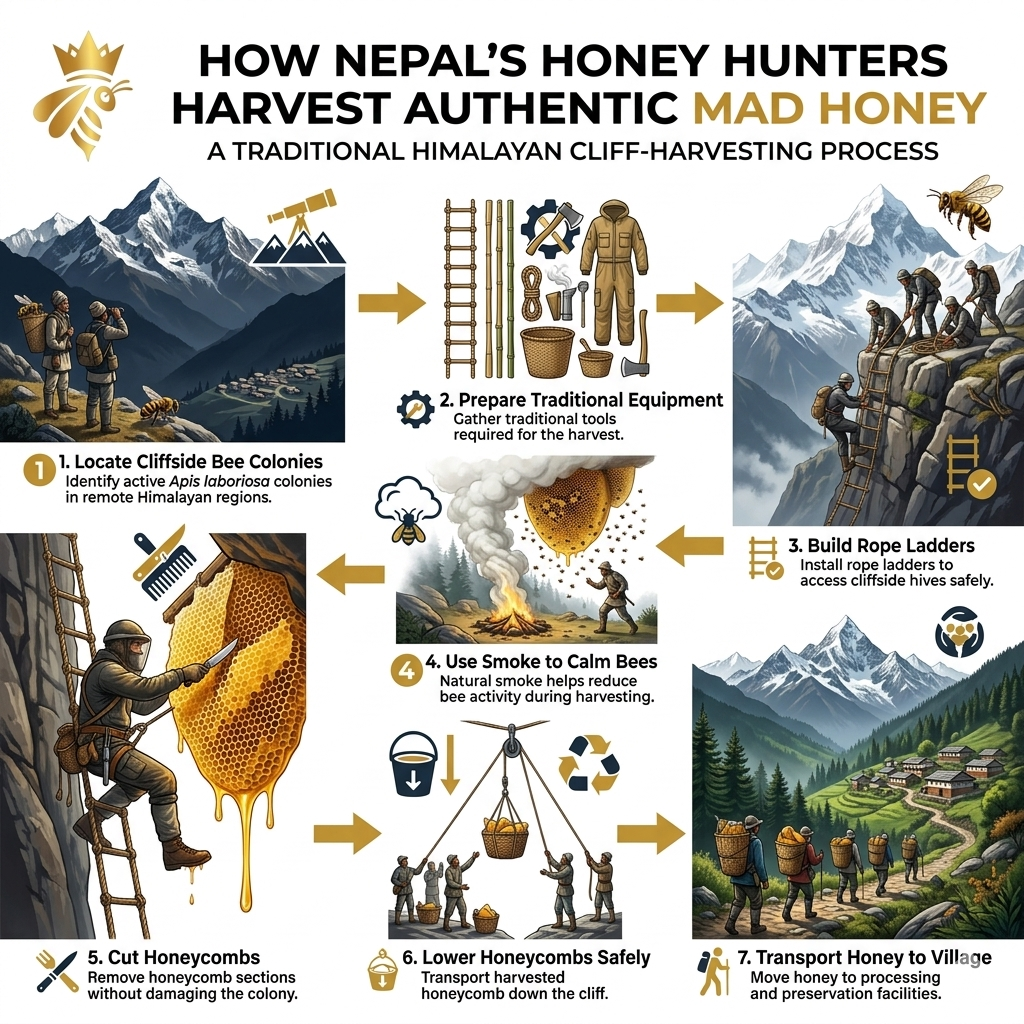
Harvesting authentic mad honey involves a carefully coordinated process that combines climbing skills, traditional knowledge, teamwork, and respect for the natural environment.
Locating Cliffside Bee Colonies
The process begins long before any honey is collected.
Honey hunters must first identify active colonies.
This often requires traveling through mountain valleys and observing cliff faces from strategic viewpoints.
Experienced hunters know which locations have historically supported large bee populations and monitor these areas throughout the season.
Preparing Traditional Equipment
Before approaching a colony, teams prepare equipment needed for the expedition.
Supplies may include:
- Rope ladders
- Bamboo poles
- Collection baskets
- Smoking materials
- Protective clothing
Each item serves a specific purpose during the harvest.
Building Rope Ladders
One of the most recognizable elements of Himalayan honey hunting is the rope ladder.
These ladders are secured above the colony and lowered down the cliff face.
A designated honey hunter then descends toward the hive while other team members manage ropes from above.
The process demands exceptional balance, strength, and concentration.
Using Smoke to Calm Bees
Natural smoke is traditionally used to reduce bee activity.
Materials such as dried vegetation are burned below the colony, creating smoke that rises toward the hive.
The goal is not to eliminate the bees but to create conditions that allow harvesting to occur more safely.
Cutting Honeycombs
Once positioned near the colony, the honey hunter uses specialized tools to carefully remove sections of honeycomb.
This stage requires precision.
Removing too much comb can damage the colony, while removing too little may make the expedition unproductive.
Lowering Honeycombs Safely
Harvested comb sections are placed into baskets and lowered to team members below.
Communication between hunters is critical during this stage.
Strong winds and uneven terrain can create additional challenges.
Transporting Honey From Remote Mountains
After collection, honeycomb must be transported back to villages or processing centers.
Depending on location, this journey may require hours of walking through rugged mountain terrain.
Only after reaching a secure location can processing begin.
Traditional Honey Hunting Equipment
Traditional honey hunting relies on specialized tools developed over generations.
| Equipment | Purpose |
|---|---|
| Rope Ladders | Accessing cliffside colonies |
| Bamboo Poles | Cutting and guiding honeycombs |
| Smoking Tools | Calming bee activity |
| Collection Baskets | Transporting honeycomb |
| Protective Clothing | Reducing sting exposure |
| Climbing Ropes | Supporting hunters on cliffs |
| Knives and Cutting Tools | Separating honeycomb sections |
Although modern equipment may occasionally supplement traditional methods, many honey hunters continue to rely heavily on tools that have been used for generations.
Real Honey Hunting Expedition Example
A typical honey hunting expedition may involve a team of 12 Gurung hunters traveling into a remote valley during spring harvest season.
After locating approximately 15 active colonies on a cliff measuring nearly 250 feet in height, the team begins preparing equipment.
Weather conditions are favorable but unpredictable.
Throughout the day:
- Rope ladders are installed
- Smoke is prepared
- Honeycomb sections are harvested
- Team members coordinate collection efforts
The expedition may yield dozens of kilograms of honey depending on colony size and seasonal conditions.
Challenges often include:
- Sudden wind changes
- Aggressive bee activity
- Difficult terrain
- Long transportation routes
Safety remains a constant priority throughout the operation.
Risks Faced by Himalayan Honey Hunters
Honey hunting remains one of the most dangerous traditional food-gathering activities in the world.
Bee Attacks
Apis laboriosa colonies can become highly defensive when disturbed.
Hunters may receive multiple stings despite protective measures.
Cliff Falls
Working on vertical cliffs introduces obvious physical risks.
Even experienced hunters must remain vigilant.
Weather Hazards
Mountain weather can change rapidly.
Wind, rain, and reduced visibility create additional dangers.
Remote Rescue Challenges
Many harvesting locations are far from medical facilities.
Emergency response may be difficult or delayed due to geography.
How Authentic Mad Honey Is Processed and Preserved
After harvesting, honey must be processed carefully to maintain quality and purity.
Most producers focus on:
- Gentle filtration
- Clean handling practices
- Controlled storage
- Airtight packaging
Proper preservation helps maintain freshness while protecting the honey from contamination.
Responsible suppliers prioritize traceability and quality control throughout the process.
Sustainability and Bee Conservation
Sustainable harvesting practices are essential for protecting both bee populations and traditional honey-hunting cultures.
Responsible honey hunters often leave portions of the colony intact.
This helps:
- Support future bee activity
- Encourage colony recovery
- Maintain ecological balance
Modern conservation efforts increasingly focus on protecting:
- Rhododendron habitats
- Wild bee populations
- Traditional harvesting knowledge
- Mountain ecosystems
Without sustainable practices, future generations may lose access to this unique tradition.
Traditional vs Commercial Mad Honey Harvesting
| Factor | Traditional Harvesting | Commercial Collection |
|---|---|---|
| Methods | Manual cliff harvesting | Managed collection systems |
| Quality | Highly variable and natural | More standardized |
| Purity | Minimal processing | Often processed extensively |
| Potency | Influenced by natural conditions | Can vary significantly |
| Environmental Impact | Dependent on harvesting practices | Depends on scale and management |
| Cultural Value | Extremely high | Limited cultural connection |
Traditional harvesting remains closely tied to local communities and cultural heritage.
How to Identify Authentic Nepal Mad Honey
Authentic Nepal mad honey can often be verified through sourcing transparency, harvest information, and supplier credibility.
Buyers should look for:
- Verified Nepal origin
- Harvest region information
- Seasonal sourcing details
- Transparent supply chains
- Quality testing standards
Common warning signs include:
- Unrealistically low prices
- No origin information
- Generic packaging claims
- Lack of harvest details
Choosing reputable suppliers helps reduce the risk of purchasing diluted or misrepresented products.
Why Mad Honey Is So Expensive
Authentic mad honey commands premium prices because production is limited and harvesting is exceptionally labor-intensive.
Several factors contribute:
- Dangerous cliff harvesting
- Seasonal availability
- Remote mountain logistics
- Skilled labor requirements
- Limited annual production
- Growing global demand
Unlike commercial honey, authentic Himalayan cliff honey cannot be mass-produced on demand.
Its rarity is directly connected to the challenges involved in obtaining it.
FAQs
Is mad honey legal?
In many countries, mad honey is legal to purchase and possess, although regulations can vary by jurisdiction.
What makes mad honey psychoactive?
Mad honey contains naturally occurring grayanotoxins derived from certain rhododendron species.
Which season produces the strongest mad honey?
Spring harvests are often associated with higher rhododendron nectar availability.
How dangerous is honey hunting?
Honey hunting involves risks including bee stings, cliff falls, and unpredictable mountain weather.
What is Apis laboriosa?
Apis laboriosa is the Himalayan giant honey bee and the world’s largest honey bee species.
How much honey is harvested from one cliff?
Yields vary depending on colony size, environmental conditions, and harvesting practices.
How long has honey hunting existed in Nepal?
Traditional honey hunting has been practiced for centuries in Himalayan communities.
Why is authentic mad honey expensive?
Limited production, difficult harvesting conditions, and global demand contribute to higher prices.
Is all Himalayan honey mad honey?
No. Only honey produced under specific conditions and floral sources qualifies as mad honey.
How can buyers verify authenticity?
Look for transparent sourcing, harvest details, origin information, and supplier credibility.
Conclusion
The story of authentic Himalayan mad honey begins on Nepal’s towering cliffs, where generations of honey hunters continue a remarkable tradition that blends skill, courage, and cultural heritage.
From the giant Apis laboriosa bee to the seasonal bloom of rhododendron forests, every stage of production is shaped by the Himalayan environment. The risks involved, the limited harvest seasons, and the dedication required to reach remote colonies all contribute to the rarity and value of authentic Nepal mad honey.
Equally important is the commitment to sustainability. Protecting bee populations, preserving traditional knowledge, and maintaining healthy mountain ecosystems ensures that future generations can continue this extraordinary practice.
More than a food product, authentic Himalayan mad honey represents a living connection between people, nature, and one of the world’s most unique harvesting traditions.
If you’re interested in experiencing genuine Himalayan honey, you can buy authentic mad honey sourced directly from Nepal’s traditional harvesting regions.